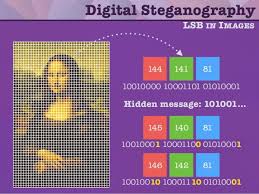
Steganography is the way of hiding a message, image or file within another message image or file. You are able to hide files of megabytes or more within the image. This practice is the way to make a message impossible to see by encryptors. The most simple form of steganography in an image is “least significant bit steganography” This technique works by putting messages in the low or rightmost bit of the file or image as a medium for hiding the message. If you have a normal pixel that is 4 bytes long, by changing the last two numbers will be able to hide an image. In a huge image changing by two levels is not going to be that noticeable, but if you start changing the highest most significant bit, then that might be an issue. Another way to hide an image is the spread spectrum technique. This is a data hidden communication method that uses digital imagery as a cover signal. Some Ways to use audio steganography through low amplitude, technique, phase coding, and echo hiding. These allowed you to hide messages in an audio. Steganography has been used for years in order to hide data, encrypting data, and to hide files.
Chat GBT answer: Weak answers to be highlighted
Steganography can be used to hide text within various digital media formats, such as images, audio files, or even within seemingly innocuous text documents. Here are a few common methods for hiding text using steganography:
- Image Steganography:
- LSB (Least Significant Bit) Technique: This method involves altering the least significant bits of the pixels in an image to encode the hidden message. Since the changes are minimal and often imperceptible to the human eye, the original image remains visually unchanged.
- Masking and Filtering: Another approach involves applying a masking or filtering technique to the image. For instance, changing the color values slightly or embedding text within specific color channels.
- Spread Spectrum Technique: This technique involves spreading the hidden message across the entire frequency spectrum of the image, making it harder to detect.
- Audio Steganography:
- Low-Amplitude Technique: Similar to LSB in images, audio files can have their least significant bits altered to encode hidden messages without significantly altering the sound quality.
- Phase Coding: This technique involves encoding the hidden message by subtly shifting the phase of certain audio frequencies.
- Echo Hiding: Embedding messages in the echo of an audio file can also be used for steganography.
- Text Steganography:
- Whitespace Steganography: In text documents, hidden messages can be encoded by manipulating whitespace characters, such as spaces, tabs, or line breaks.
- Font or Style Alteration: Concealing text by slightly altering the font size, style, or color within a larger body of text.
- Format-based Steganography: Utilizing the formatting options within a document format (e.g., Microsoft Word) to embed hidden text.
Regardless of the method used, the key challenge in text steganography is to ensure that the hidden message is imperceptible to unintended recipients while remaining recoverable by those who possess the appropriate decoding method or key. Additionally, it’s important to note that while steganography can conceal the existence of a message, it does not provide encryption or protection against interception or analysis by sophisticated adversaries.
This did not explain how to hide the message it juts explained the names of the methods.
Analysis: after researching about this topic, about 90% of my findings in my analysis is from my notes and the videos watched in about 10% is used from ChatGPT.